
Three myths that keep good firms stuck
The deep, mostly unspoken stories a firm tells itself about how growth happens, and a truer picture for each.
In 2008 I interviewed six founders about how crises had shaped them and their companies. One pattern I saw was this: behind our actions sit intentions; behind intentions sit attitudes; and beneath those are deep, often unexamined beliefs about how the world works. A crisis arrives when that ingrained understanding no longer fits our reality. It forces us to confront the inadequacy of our old assumptions and rebuild a more coherent worldview from the bottom up. Painful, but often transformative.
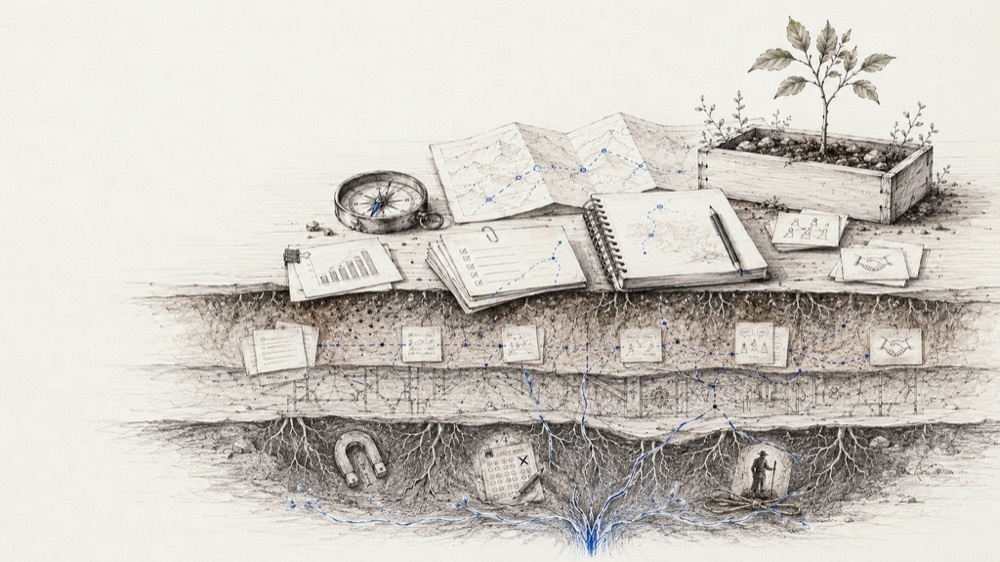
My current work in Futures Studies brought me back to it, through an approach far less disruptive, but with similar transformative potential. Causal Layered Analysis, or CLA, is a method from futures work developed by Sohail Inayatullah. It asks us to lift the bonnet on purpose and look at what is running underneath, down through four layers: the litany, the systemic causes, the worldview, and the myth at the very bottom. Then CLA challenges us to examine those myths, and offers the chance to replace them with new stories that reshape the systems and outcomes above them.
Across the first four BDF Insights pieces I touched the upper layers of one problem: why good technical firms struggle to grow. This piece explores the bottom layer: the myths, the deep, mostly unspoken stories we tell ourselves about how growth happens. These stories are held in technical services firms for a reason. The work itself is complicated, the kind of hard, knowable problem that rewards expertise and the right answer, so a firm naturally carries the same instinct into how it grows. But growth is not merely complicated; it is complex: relational, emergent, and shaped by perception over time. The habits that master a complicated problem mislead you in a complex one. Here I suggest three of them, surfaced as myths, with an alternative for each. Underneath all three sits one story: that growth is a complicated problem, and that solving the work well will be rewarded.
The Magnet: good work does not pull clients in by itself
The first myth is that good work pulls clients in by itself. Do excellent work and the work will speak for itself; referrals will come, reputation will travel, and going out to find work is unnecessary. It holds for a while, which is what makes it alluring, and eventually growth stalls while the work is as good as it has ever been. The trouble is that a client cannot buy what they cannot see, and trust, though real, is reactive: it sits between specific people and waits to be called on. So the firm that holds the Magnet stops doing the very things that compound growth.
An alternative picture is the Engine. Good work is the engine, and an engine is a fine thing, but on its own it only runs. It moves the firm forward only once it is connected to the wheels, which is the job of a deliberate BD system.
The Exam: winning work is not a cold evaluation
The second myth is that winning work is a cold, objective evaluation, like sitting an exam. The tender is marked, the strongest technical answer scores highest, and everything else is just paperwork. A firm that holds it waits for the tender to land before it engages, rather than getting into the conversation early, while the problem is still being shaped.
Winning work is closer to Courtship than examination. You are less a candidate being marked from a distance than a suitor hoping to enter a relationship. The criteria are as much unspoken as spoken, and they settle across many small interactions long before anything is written down. This does not mean the formal bid does not matter: procurement is getting stricter, and a strong relationship will not rescue a weak submission. The point is that the exam is the formal stage of a courtship that has been forming, or not, long before the tender.
The Lone Hunter: growth cannot ride on one person
The third myth is that growth rides on one special person. A rare rainmaker, or the founder, goes out alone and brings back the work, and it cannot really be taught or shared. What the myth produces is dependency, a ceiling the size of one person's diary, and a cliff edge the day that person leaves or burns out.
Keep the hunter, who is genuinely valuable; the change is to end the solitude and demystify the craft. Move from the lone hunter to an Organised Hunt: a disciplined way for the firm to approach the terrain together. The hunter still goes out, but now with a compass, a map, and a party around them. The compass is strategy: where to look, what to ignore, and which opportunities are worth effort. The map is shared intelligence. The party is the wider firm. Growth then becomes something the firm owns rather than something it borrows from one person.
Notice that none of these is fixed by surface effort alone. More proposals will not cure the Magnet, a better document will not cure the Exam, and a second rainmaker will not cure the Lone Hunter. The real change sits lower down, in the belief the behaviour rests on, which is exactly why these problems are so stubborn.
So here is the invitation. The next time something in your firm keeps not improving however hard you push at it, treat that as a signal rather than a failure of effort, and walk it down the layers. Start with the litany, the thing everyone says. Drop to the system, the structures and incentives that keep producing it. Drop again to the worldview that makes that system feel normal. And look, at the bottom, for the story you have never examined. A crisis forces a firm to look there. This is a way to look before one arrives.
Which of the three myths does your firm hold? Tell us, and we will tell you what we would check first.
Get in touch → Score your firm on the eight dimensions