
In search of a BD system for technical services firms
The methods on offer were built for other kinds of firm. What a system for technical services has to do, what is worth borrowing from each, and where the gap is.
The previous piece set the ground: what business development is, that it begins with a clear strategy, and the three foundations a technical services firm grows on, namely service, trusted relationships, and visibility. What kind of system serves all of that, and does anything off the shelf already do the job?
The system must follow strategy, stay light, and belong to the team
The work it serves is bespoke and judgement-led: technical services firms deliver real, tangible outcomes, but not standardised, repeatable work, and what the client is really buying is judgement they cannot fully evaluate up front. A system built for that kind of work has to meet a few tests, which fall into three.
- What feeds it: strategy. It has to take its direction from the firm's strategy. The system is generic in shape, but its decision points carry criteria that each firm sets from its own strategy, so effort points at where the firm has chosen to grow rather than running as an activity of its own.
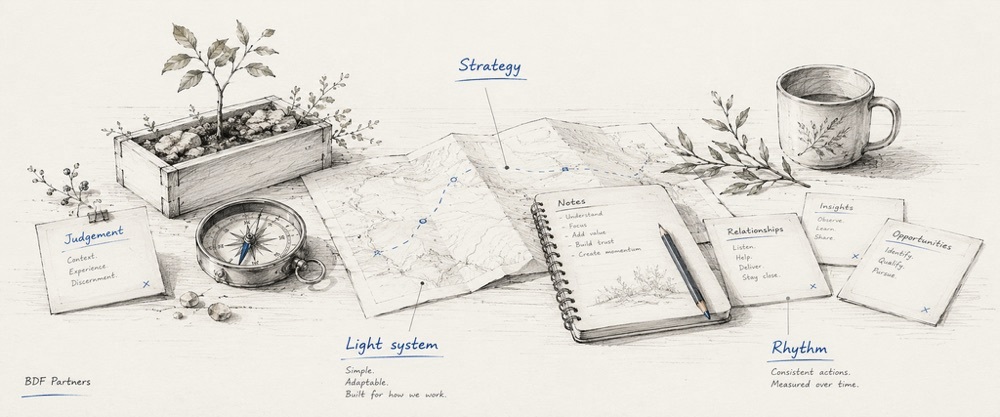
- How it runs: light, flexible, a compass not a rulebook. It has to be light enough to survive a busy delivery month and never harden into bureaucracy, yet have enough structure to capture what matters. Anyone should be able to map an opportunity onto it and read the next step. And it has to be flexible and scalable, so elements can be emphasised or set aside depending on where the firm and the opportunity are.
- What it produces: growth on all three foundations, owned by the team. It has to serve all three foundations together, excellent service, trusted relationships, and visibility, not just one or two. And it has to build the team's capability rather than depend on one person, whether or not the firm has a full-time business development lead.
The processes I knew were adapted, and built for large organisations
I did not start by inventing anything. I started by looking, because if there were a system on the shelf that met those tests, it would save everyone a great deal of time, and I would happily have used it. I also wanted my own approach placed in context: built on solid foundations, defendable, and giving credit to the good work already done by others.
I have spent two decades in this work first-hand, on everything from small secondments to very large pursuits, across countries and industries. Along the way I have worked inside the business development processes of large firms, and each one helped, but each also fell short in the same two ways. They had been adapted for technical services rather than designed for it, so the fit was never quite right. And they were built at a scale that suited large organisations, not the reality of a small or mid-sized firm, where there is no dedicated sales function and the people who would run the system are the same ones delivering the work.
Existing methods were built for other kinds of firm
The most rigorous proposal and pursuit discipline comes from military and government contracting, and the capture- and proposal-management profession that grew up around it. There is a great deal worth taking: the phase-gated approach, clear gate criteria, structured governance reviews. But there is far too much of it to fit a sixty-person engineering firm. You take the principles and leave the machinery.
A second body of work comes from enterprise and product sales: consultative and solution-selling methodologies, and the approaches that lead with insight. These carry product-sales assumptions: a repeatable offering, a fairly defined buyer, and a transaction to close. A technical services firm has none of those things. Even so, I have borrowed from this strand: the discipline of mapping the client, who decides and what they truly need, and leading with insight rather than features.
A third strand speaks directly to professional services: David Maister on how professional firms differ, and the research on how technical experts become known and sought out. The core idea travels well: a firm that is clear about what it does and the value it brings does not have to chase every opportunity. Maister argued decades ago that a firm's existing clients are its best source of new work, because the trust is already there, the cost of winning is lower, and the follow-on work is usually more profitable. That sits at the heart of the approach that follows.
The most recent evidence complicates the comfortable story. A 2023 Harvard Business Review article, built on a study of nearly 1,800 professional-services partners and a survey of about 100 senior buyers, reports two things worth holding onto. Client loyalty is fading: where roughly three-quarters of buyers once preferred to re-engage a firm they knew, only about half do today. And the approach that most reliably wins work is neither the deep expert who waits to be sought out nor the trusted adviser who expects the client to return; both, on the data, underperform. What works is the proactive pattern of broad relationships across a client's organisation, useful insight before a need hardens into a tender, and protected time for business development. The lesson is to build those behaviours into a light system the whole team runs.
| Approach | Where it comes from | Worth borrowing | Why it doesn't fully fit |
|---|---|---|---|
| Capture & proposal management | Military & government contracting | Phase gates, gate criteria, governance reviews | Built for huge, compliance-heavy bids, so borrow the elements, not the machinery |
| Consultative & solution selling | Enterprise & technology B2B sales | Mapping who decides and what they need; needs-first questioning; qualification discipline | Assume a sales function and a transaction to close, and carry product-sales framing |
| Insight-led selling | Enterprise B2B sales | Leading with insight and a point of view, not features | Built around a sales force and a repeatable pitch |
| Professional-services strategy writers | Professional services | How to position, price from expertise, and grow existing-client work | Excellent on strategy and firm economics; lighter on the week-to-week operating rhythm |
| Recent partner-performance research | Professional-services BD research | Evidence that proactive, network-building, value-creating behaviour and protected BD time drive growth | A behavioural finding about individuals, not an operating system |
The under-served approach is a light, strategy-led system
Having looked across all these models, I wanted to test one thing: is there a real gap here, or am I simply talking myself into preferring my own approach? The way to check is to find the few dimensions that separate BD approaches from one another, and see where they cluster. Two came through as the real structuring forces. The first is where business development lives: in capable individuals, or in a system the firm owns. The second is what it is focused on: winning today's work, or positioning for where the market is heading. Set those against each other and the field sorts into four broad types.
| Individual-led | System-led | |
|---|---|---|
| Future / strategic | 1. Advisor / strategist. Strong thinking, insight and positioning, but tends to stay in one or two heads and drift from the week-to-week work of winning. | 2. A light, strategy-led BD system. Turns strategy and market foresight into positioning, a pursuit rhythm, sound proposals and repeat work, owned by the firm rather than trapped in one person. |
| Present / operational | 3. Rainmaker / doer-seller. Growth rests on a few capable people, their relationships and personal drive. Powerful early, but fragile and hard to scale. | 4. Sales process / CRM discipline. Useful structure, but without strategy and client insight behind it, it turns into mechanical box-ticking, the very thing technical people resist. |
The under-served square, especially for small and mid-sized technical services firms, is the top right: a light, strategy-led system. None of this dismisses the rainmaker; the system in the top-right still needs senior people who can win work. The difference is that it no longer leans on each of them to work it out alone.
That top-right square is the gap I set out to fill. The next piece describes what I built for it: the BDF Process, in four phases.
To explore how this applies to your firm, start with a short conversation. No deck, no pitch.
Get in touch → Score your firm on the eight dimensions