
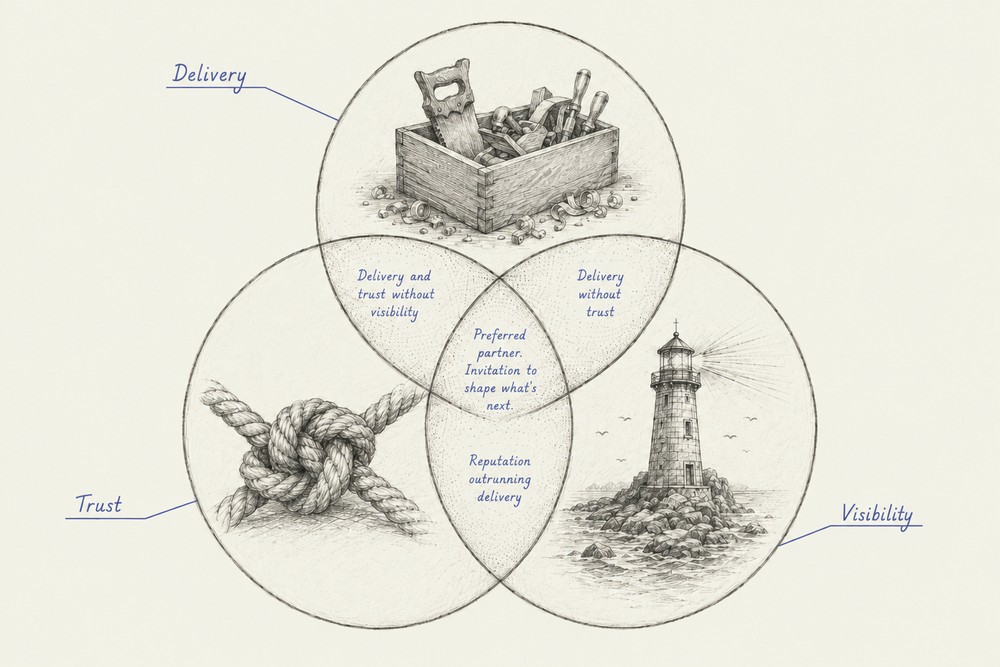
Three ways a good firm stalls
Delivery, trust and visibility. Which one is missing determines how growth stalls.
Three things grow a technical services firm.
Delivery. This is the excellent service of the earlier pieces. The work is good.
Trust. The clients rely on you, and specific people would be sorry to lose you.
Visibility. People in your market know you exist, and you are present before the work is formally defined. If they do not know you exist, they cannot appoint you.
Taken one at a time, none of those will surprise anyone: do good work, earn trust, be known.
The list is not the interesting part. It is that the three build up and run down at very different speeds, and that the third one only looks after itself with the clients you already have. Everywhere else it has to be made on purpose. The three failures below each start there.
The three foundations are not symmetric
All three carry an accumulated state. You do not do trust, and you do not do visibility. You do particular things, and a level rises. Even delivery carries forward, through the evidence and the expectations left by the work you have already done. What separates the three is how fast each one fills, how fast it drains, and whether anyone in the firm is answerable for it.
In the kind of firm I am describing, one that grew on its own work rather than on a founder's borrowed profile, delivery fills fastest and drains fastest. It is being replenished or damaged on every live project, and everyone in the firm knows who owns it.
Trust fills more slowly, one relationship at a time, and it drains slowly too. It has owners, more or less, because it is attached to named people.
Visibility fills slowest and drains slowest of the three. With the clients you already have it fills for free, because delivering well keeps you in front of them. Beyond that circle it does not fill by itself at all. That is why a firm never learns to fill it on purpose, and why, years later, when the referrals thin out, there is no method to fall back on and nobody whose job it is to notice.
The long drain is the dangerous part. A reservoir that empties slowly can be running down for years while the firm still hears the same compliments. Three familiar failures follow from that.
Reputation without delivery keeps paying out for years
The large-firm version of this is familiar: brands that have outlived the work that built them, clients who now want evidence rather than a logo. The firm is known for something it no longer reliably does. Invitations still arrive. Shortlists still carry the name. The market has not yet caught up with the substance.
Reputation is not a fourth foundation. It is what visibility leaves behind once delivery and trust have been filling it for years, which is exactly why it can keep paying out after they have stopped.
The usual explanation is hubris, that the firm began believing its own story. I do not think that is the mechanism, and blaming character makes the problem much harder to see in yourself. Scale usually brings a pyramid, and a pyramid means the work that built the reputation is increasingly done by people who were not there when it was built. Nobody decides to stop delivering. The same economics that let a firm monetise a reputation can become the economics that dilute the delivery which created it. Not every firm lets that happen, and the ones that do not have built something deliberate to prevent it.
What makes this dangerous is the lag. The tank drains slowly, and the whole time it is draining the firm keeps receiving the reward signal: the calls, the invitations, the sense of standing. There is no moment at which the market tells you to correct. By the time it does, the correction is expensive. I do not know how long the lag runs, and I suspect it is longer than anyone plans for.
The small-firm version is not milder, it is faster. The founder's name is the tank. A firm can trade on a founder's reputation for years while the founder does less and less of the work that earned it, and the first honest signal arrives when a client who assumed the founder would be on the job finds out otherwise.
Delivery without trust leaves a firm always eligible, never preferred
This one is harder to see and it is almost never diagnosed, because the work is good, so nobody thinks to look further.
The firm delivers well. It scores well. It is compliant, competent and entirely substitutable. It sits on the panel and gets re-tendered every time, because the relationship is with the contract rather than with a person. Nobody inside the client would find it awkward to replace them.
The symptom is specific. Always eligible, never preferred.
Feedback after a loss is polite and empty. The client contact is a project manager rather than anyone who sets direction, and every new piece of work starts from zero as though the last three had not happened.
There is a real tension here. Some of this is not the firm's doing. Parts of this market are deliberately designed to prevent preference, and against a genuinely blind scoring process relationship depth does not help you and is not supposed to. So the useful question is not how to make them like you. It is whether this client is structurally capable of preferring anyone. If the answer is no, price the work accordingly and put the relationship effort where it can compound. If the answer is yes and they still do not prefer you, trust is the missing foundation, and no proposal will fix it.
Delivery and trust without visibility looks healthiest from the inside
This is the common one in technical services, and it is the one that looks healthiest from the inside.
The work is excellent. Three or four clients would be genuinely sorry to lose the firm. And almost nobody outside that circle knows the firm exists.
The Harvard Business Review article I drew on earlier in this series describes this position. Roughly three-quarters of buyers once preferred to re-engage a firm they already knew. Only about half do today, and more work goes out to tender even from long-standing clients. Two of the weaker performers among the partner profiles it measured were the deep expert who waits to be sought out and the trusted adviser who expects the client to come back. Both describe a firm with two strong foundations and a missing third.
Growth in that position rides on the founders' relationships. It works until those relationships saturate, or until the founders get pulled into delivery, which happens every time the firm wins something large. In the firms I have worked in and with, the ceiling arrives somewhere in the middle of the growth curve, and when it does it is almost always read as a market problem rather than a structural one.
It stays unfixed for a plain reason. Visibility comes in two forms and firms own them unevenly. There is brand and marketing, the broadcast side, and plenty of firms own that and review it properly. And there is being in front of particular people while the work is still being shaped. That second one rarely has an owner, because it is not marketing's job and it is not delivery's job, so it sits between them.
This is also where treating business development as marketing and sales goes wrong. Marketing covers the broadcast half of visibility. Sales covers the end of the process, once there is something to respond to. Between them they touch part of one foundation. Delivery as a source of proof, trust as something that accumulates with named people, and being present before the scope exists are all outside that definition, and those are where most of the growth comes from.
A weakness in one foundation shows up as a symptom in another
Anyone can write down three things and say you need all three. That is not worth publishing.
The three feed each other in a loop. Good delivery creates proof. Proof and repeated contact build trust. Trust opens doors and produces referrals, which is visibility arriving without being asked for. Visibility puts the firm into more of the right conversations early, and those conversations produce better-fitting work to deliver.
Break one link and the other two can hide the damage for a surprisingly long time. Which means a weakness in one of the three almost always shows up as a symptom in another. A firm that keeps losing bids reads it as a proposal problem and buys proposal training. If the real break is that they were invisible while the scope was being written, better proposals will improve nothing, and the failure gets read as evidence that the market has got tougher.
Many firms are working hard on the wrong foundation, because they are working where the symptom is visible rather than where the break is.
I wanted to know how much that costs, so I built the loop above as a simple simulation and broke the visibility link in it. One firm then does nothing in particular. The other does what firms actually do, and lifts its delivery quality and its proof of capability by a quarter. Six years later, the second firm has recovered about a tenth of the ground it lost.
Be clear about what that number is and is not. It comes from a model of the argument in this article, not from a study of real firms, so it tells you what follows if a firm is shaped the way I have described and nothing at all about whether yours is. What it does usefully kill is the intuition that working harder on the part you are already good at will eventually pull you out. On this structure it does not, and it costs six years to find out.
One boundary worth stating plainly. These are three failures of a missing foundation. There is another kind, where nothing is missing and the failure is one of rhythm: a firm wins something large, the senior people vanish into delivery, and the visibility work stops for two years without anybody deciding to stop it.
Count what decided your last ten pursuits
Take your last ten pursuits in order, wins and losses together. For each, mark the single factor that most influenced the outcome.
Delivery. Our capability, our evidence of having done it before, and our technical answer were what decided it, for us or against us.
Trust. It turned on who they already knew. Either they went with someone they trusted, or we won because they trusted us.
Visibility. We did not know about it until it was published, and we were responding to a scope somebody else had helped shape. Or, on the wins, we were in the conversation early and the scope had our thinking in it.
Then count the columns. Often one of them dominates, and it may not be the one the leadership team has been working on. That distribution will tell you more than another discussion about whether the firm is doing enough business development, and it costs an hour.
It is worth knowing why that hour is hard to find. The foundation you are not maintaining is invisible to you, precisely because the other two are still producing results. That is not a failure of attention. It is what a system with a lag in it feels like from the inside.
Which is why the useful question is never whether you are doing enough business development. It is narrower, and more awkward: which of the three are you living off rather than filling.
Done the count of your last ten pursuits? Send us the three totals and we will tell you where we would look first.
Get in touch → Score your firm on the eight dimensions